

When the Strait of Hormuz closed earlier this year, there was a familiar rush of commentary about how badly the energy shock might play out in Africa. In response, Zainab Usman and Ken Opalo both warned against the tendency to ‘catastrophise’, noting that African economies have proved more resilient than expected in previous crises. In a similar vein, Yuen Yuen Ang has been critical of the doom-laden zeitgeist of ‘polycrisis’, which she argues denies countries agency in crafting their responses to a volatile international environment.
I have a good deal of sympathy with all of this: much crisis coverage is reductive, over-generalised and quick to alarm. But in the months that have followed, I have also found it quite hard to find detailed analysis of how the conflict in the Middle East is affecting different African economies.
One way to help get away from this catastrophising tendency is to look backwards rather than forwards and to try to better understand the mechanics of how specific shocks propagate (or not) through to national economies. The impacts can linger on long after journalistic interest has passed; while by the same token other dire warnings turn out to be overblown. These patterns can vary significantly across countries and different kinds of economy.
Making crises more easily legible is not straightforward. Reverberations from events in the Middle East (or Russia and Ukraine before) depend on the interaction of many moving parts. Effects run through goods markets, fuel, fertiliser, food, which can be affected in turn by international financial markets, the weather and social unrest or even conflict. The effects of shocks also play out with a lag, and some of the damage does not reverse: less a tyre bursting than one slowly deflating.
For this piece, I try to trace out how the 2022 and 2026 shocks have seemingly affected the four largest economies in East Africa (Ethiopia, Kenya, Tanzania and Uganda) drawing on publicly available information. I pay particular attention to the role that external constraints can play in further amplifying and reinforcing shocks in fuel, food and capital markets and what that might mean for efforts to reduce the exposure to shocks still to come.
1. The 2020s vintage of shocks to real things
A lot of the literature on economic shocks focuses on business cycles or international capital flows and how macroeconomic policies can (or cannot) dampen their impact. A distinctive feature of the crises in this decade has been disruptions in international markets for critical inputs to economic production. Changes to interest rates and counter-cyclical fiscal policies have limited purchase when it comes to dealing with physical shortages of energy supplies.
Energy markets
While the conflicts in the Middle East and Ukraine each have their own specificities, there are clear parallels in how they affected markets for energy and fertiliser. When Russia invaded Ukraine in February 2022, oil and natural gas prices in Europe and Asia spiked and stayed elevated for close to a year. The rise in gas prices was especially severe. Europe had been heavily reliant on gas piped from Russia, and it is much harder to reroute natural gas than oil, so the cost of gas spiked at more than ten times the previous year’s price and has remained higher since.
European gas spiked sharply in 2022. The 2026 energy shock has been led by oil, where concerns over global supply have resurfaced in September.
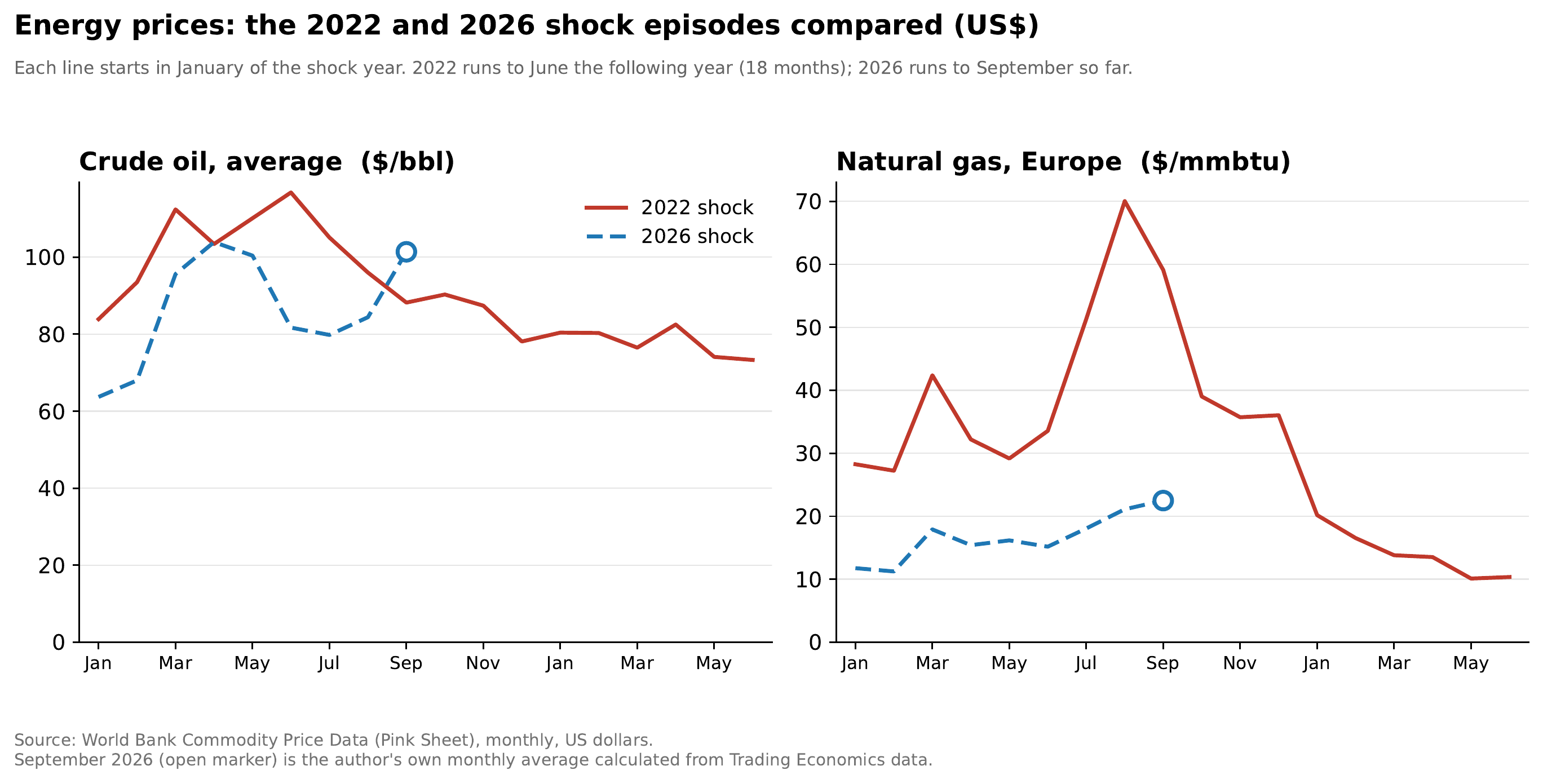
East African energy systems do not rely on imported natural gas in the way many European and Asian economies do. However, the region has its own version of that exposure. Where gas underpins the industrial base at the core of the German economy, diesel underpins East Africa’s agricultural base. Transport alone runs to around 16 per cent of the final maize price, and running the pumps, cold stores and mills adds further diesel-related costs. In each case, a core part of the economy’s productive heart runs on a single imported fuel it can neither quickly substitute nor reroute. The region’s diesel is imported: it arrives through a handful of ports, and there is no domestic alternative when the price moves.
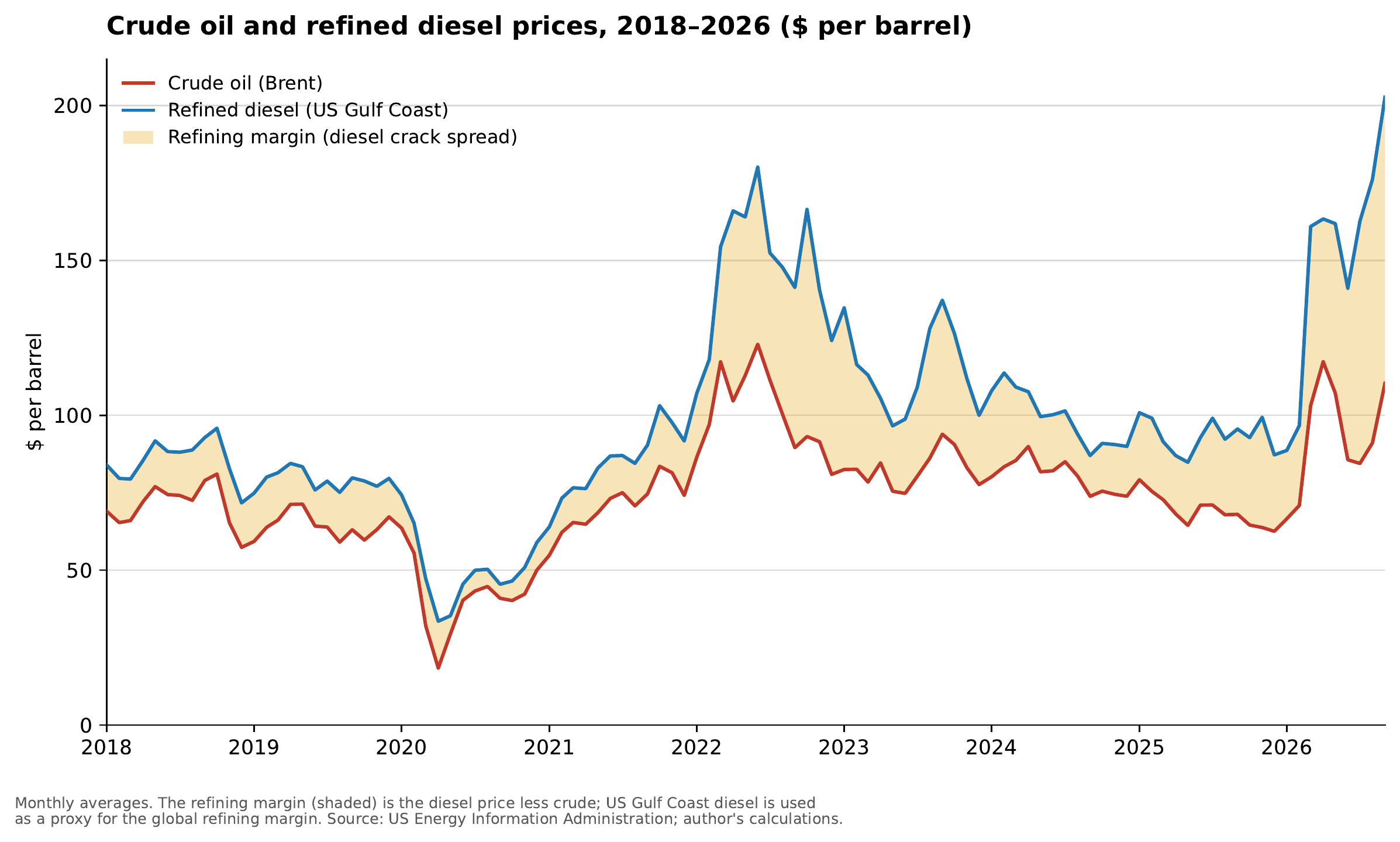
On the face of it, the increase in crude prices looked to be more severe back in 2022 than 2026 (certainly up until the last month). A comparison of international benchmark prices does not capture well the specific pressures on the costs of importing refined fuels. Diesel and petrol are refined products, so what an importer pays reflects not just crude but the cost of turning crude into fuel. Given the conflicts in the Middle East and Ukraine’s recent strikes on Russian refineries, that margin has widened sharply. It is difficult to know the exact refining margin being paid in East Africa, but in the United States, the ‘refining margin’, normally around $14 a barrel, blew out past $70 in 2022 and by September 2026 had reached some $92, wider than at any point in the earlier crisis. In addition, East African importers have faced elevated premiums for freight and insurance.
By September 2026, the refining margin for diesel was wider than at any point in 2022
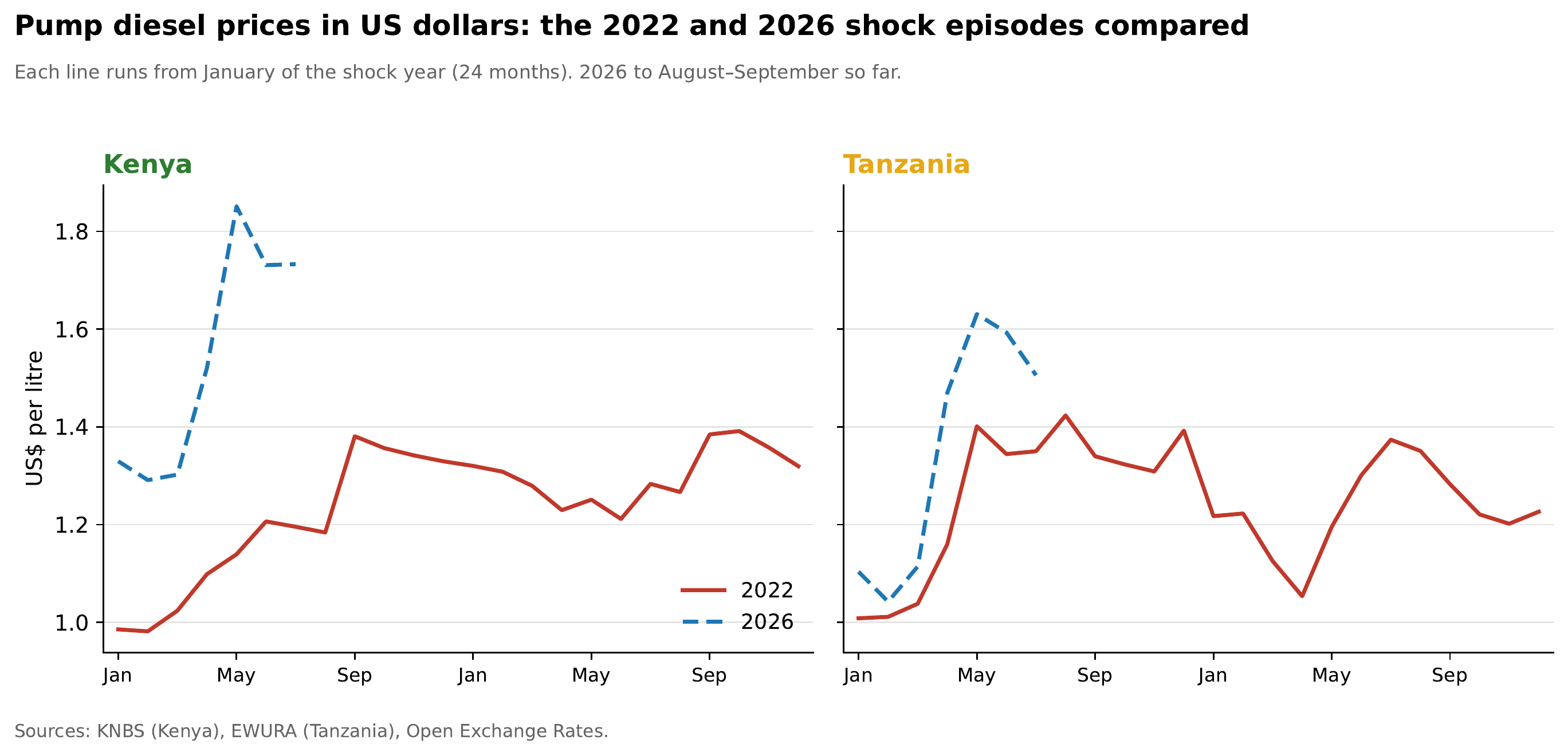
The chart below shows how the increased costs of imported diesel have been translating into higher pump prices in Kenya and Tanzania (the two economies where recent data on fuel prices is available). Retail prices have risen both more sharply and higher than in 2022, reflecting both cost pressures and differing approaches to ‘cushion’ the increases through tax and subsidy policies. The price increase back in May resulted in nationwide transport strikes in Kenya, even after the government moved to reduce VAT on fuel.
Pump prices have risen higher and faster than in 2022
An even sharper concern relates to threats to the physical availability of refined fuels and the knock-on effects for production in the economy. When diesel cannot be found to move a crop to market or run a generator, production does not just cost more, it stops altogether. Businesses may be forced into administration if shortages are not quickly addressed.
In 2022, there were instances of temporary fuel shortages in East Africa, but they were primarily related to affordability issues. In Kenya for example, the government accumulated significant arrears with oil-marketing companies, leading to queues at the pumps and fuel stock-outs in April 2022. Strains in Kenyan fuel supply were not only a Kenyan problem: they spilled across the sub-region, where access to tight supply became a source of friction. Uganda, Rwanda, Burundi and South Sudan all largely draw their fuel through the same corridor.
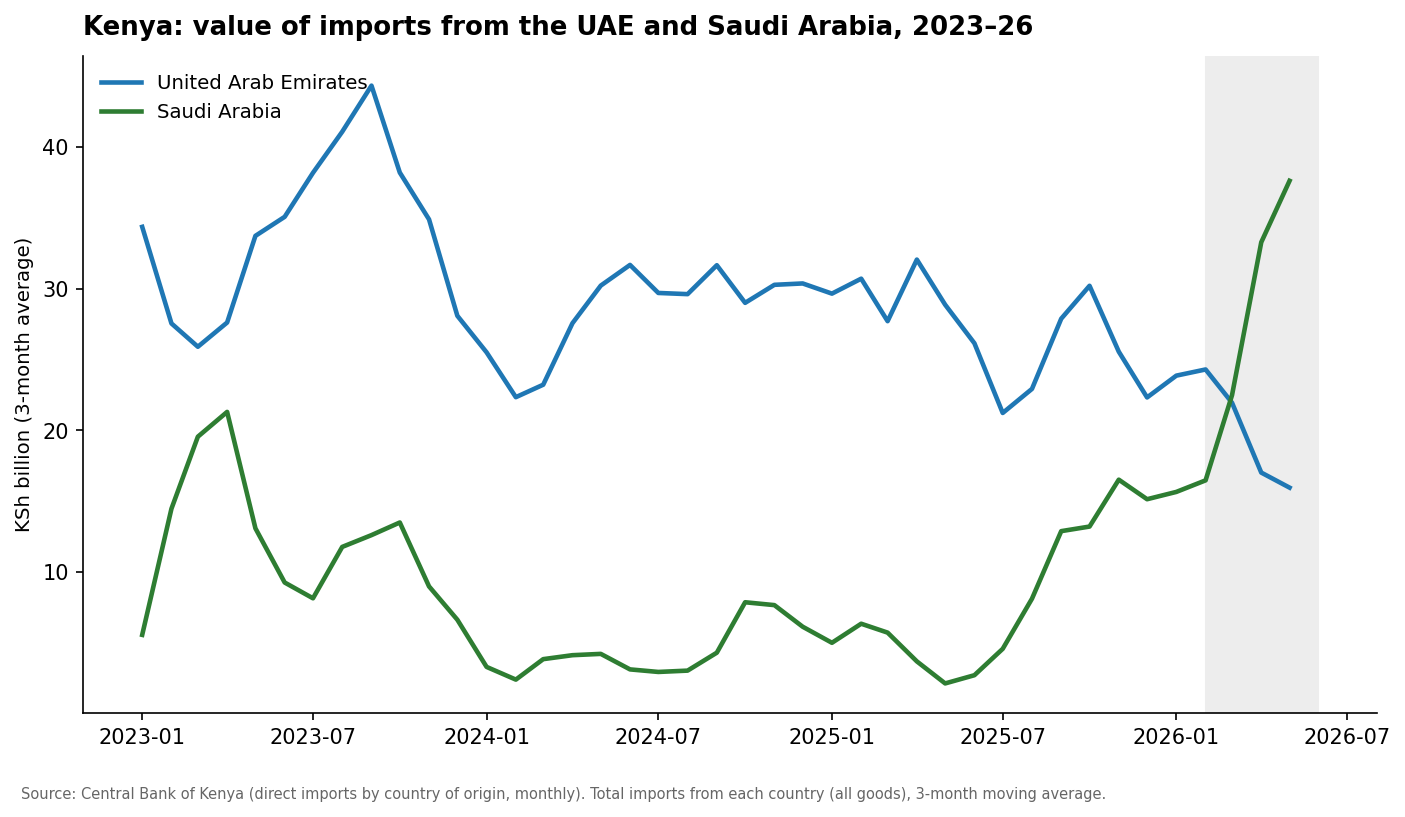
In 2026, the risk is potentially of a different kind: not so much whether fuel can be afforded, but whether it can be secured at all. The year has already shown this is no abstraction: when the Strait of Hormuz closed, an ADNOC refinery supplying Kenya declared force majeure, and Gulf suppliers told Ethiopia they could no longer meet their obligations, stranding over a hundred thousand tonnes of contracted fuel.
In the event, the initial shortages proved short-lived. The chart below shows how Kenya’s UAE supply through Hormuz gave way to Saudi barrels routed via the Red Sea. Ethiopia bought refined jet fuel from Nigeria’s Dangote refinery rather than its historical supplier, Kuwait. Uganda secured imports of refined fuels from India.
As Hormuz closed, Kenya’s fuel supply swung from the UAE to Saudi Arabia
The threat of physical shortages is a danger that remains open. The recent attacks on Saudi Arabia’s East-West pipeline (the very route that made the Red Sea alternative possible) are a reminder that the picture of global fuel supply remains unsettled. Nobody knows what will happen next in international oil markets (as illustrated by JP Morgan’s recent widely reported investor note) because of uncertainty around whether the conflict widens and supply routes for refined fuel stay passable. A sufficiently large physical break in the supply of refined fuels could behave less like the modest move in Brent prices and look more like the European gas spike of 2022.
Fertiliser markets
In 2022, when gas prices spiked in Europe and Asia, it fed straight through to the global prices of nitrogen-based fertilisers. Fertiliser is a globally traded commodity which, unlike gas, can be easily shipped. More than two-thirds of Europe’s ammonia capacity was idled because fertiliser production became too costly and Russian and Belarusian supply of fertiliser was also disrupted. The disruptions to European production and its impacts on the global supply of fertiliser fed through to prices faced by buyers around the world including East African farmers. Expensive gas kept both the cost of making fertiliser high and much capacity offline for the better part of a year.
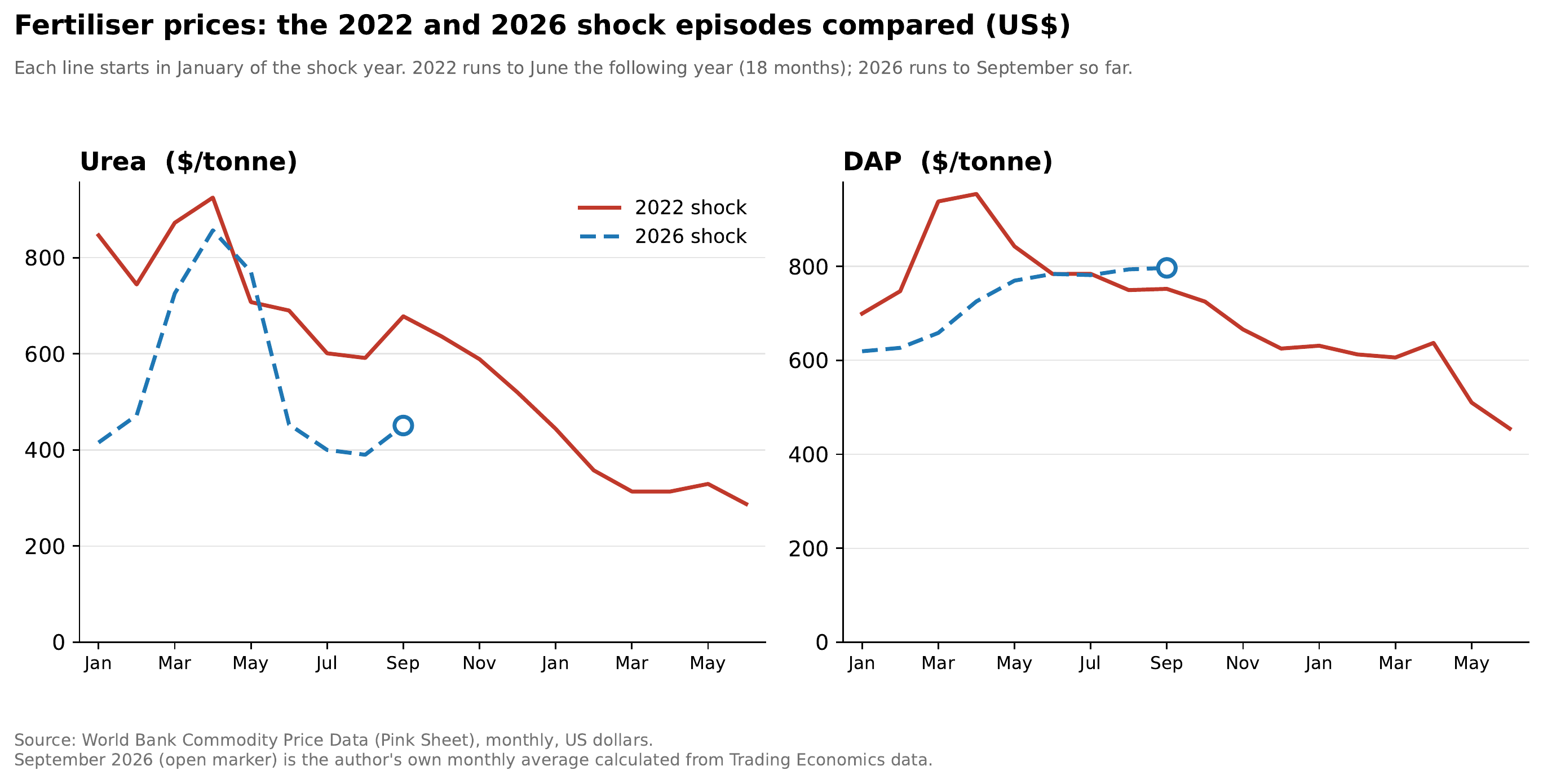
After an initial spike, international urea prices have come back down relatively quickly in 2026
There is no industrial-scale fertiliser production currently located in East Africa and so the region is vulnerable to imported-price movements and physical shortages. Ethiopia is by far the most exposed to disruptions to fertiliser imports because it uses fertiliser more intensively in agricultural production (Uganda in contrast uses almost no inorganic fertiliser at all). This exposure should not be read on its own as a sign of economic weakness. Unlike its neighbours, Ethiopia has achieved significant productivity growth in its maize farming doubling its yields between the 1990s and 2010s. This is the result of a package of interventions including making greater use of inorganic fertilisers.
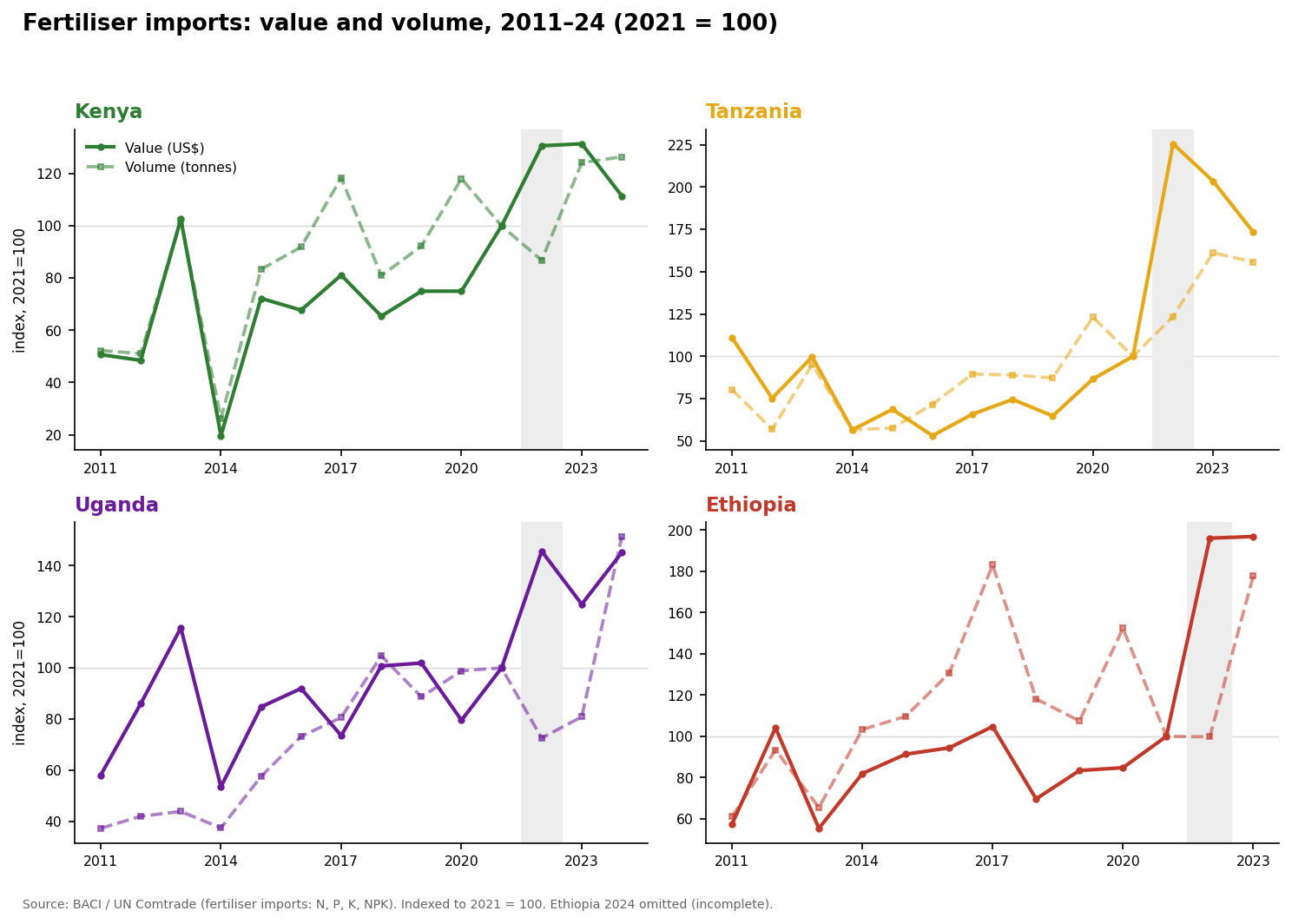
Increases in fertiliser prices raise the costs of agricultural production (borne by farmers or in part by the government). Higher costs can also result in reduced application of fertiliser which can depress yields in seasons to come. It is difficult to get exact data on fertiliser usage, but the chart below showing import values and volumes would suggest that there was a reduction in fertiliser demand in 2022 relative to long-term trends.
The region imported (and applied) less fertiliser in 2022 when the costs of imports rose sharply
It is too early to tell how fertiliser prices have affected application in the most recent planting season; but developments in fertiliser markets have been less dramatic in 2026 than 2022. Prices of urea rose earlier this year given the Gulf’s role in global fertiliser production, but came back down relatively quickly. Other fertiliser exporters, notably Egypt and Nigeria have responded to fill supply shortages from the Gulf. Depending on procurement timings and growing cycles, farmers (or governments) may have been spared the worst of the price increases. The Ethiopian agriculture ministry, which handles much of national fertiliser procurement, suggests it locked in contracts before the conflict. Prices of phosphate-derived fertiliser remain elevated, for reasons largely unconnected to recent developments in the Gulf.[1]
Food markets
Grain prices were another of the defining headlines of 2022. Russia and Ukraine are both major wheat exporters, and the war posed threats to global supply. Although the region’s wheat is largely imported (with the exception of Ethiopia), it is eaten mainly in cities. The chart below shows that maize prices, grown within the region, also rose sharply through 2022 and in 2023.
In 2022 and 2023, locally produced maize prices rose as much or more than imported wheat
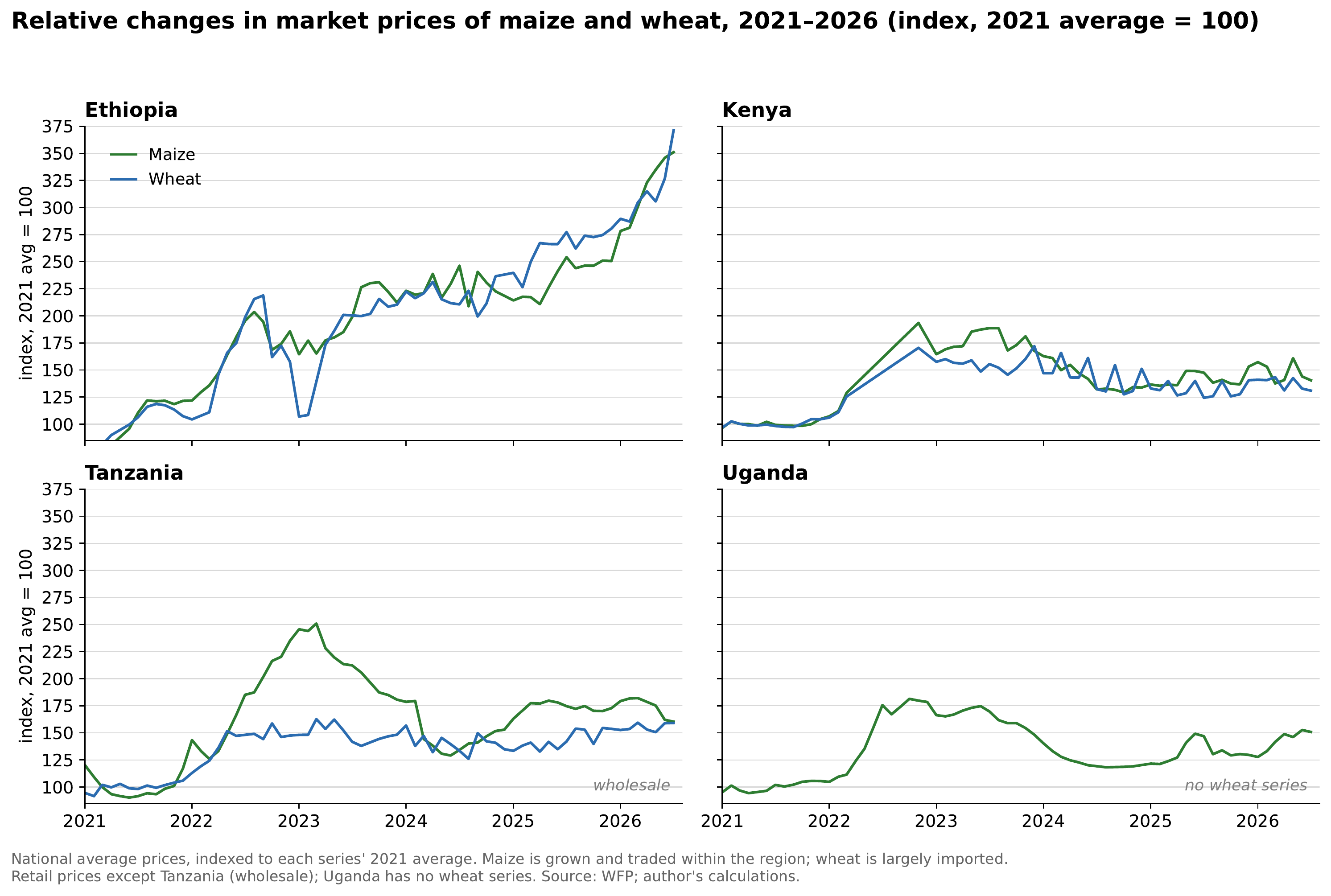
Part of the price increase relates to the rising costs of inputs used in production that then take time to work through into retail prices. This should not however just be read as a fuel-and-fertiliser story. The onset of the Russia-Ukraine war also coincided with a prolonged drought in East Africa. Tanzania’s price spike in 2023 was also linked to the drought that affected its 2021 and 2022 growing season. When the rains returned in 2023, prices eased back towards pre-drought levels across most of the region.
In 2026, price pressures in maize markets are seemingly more muted, however the worst impacts may still be to come given the time taken for higher input costs to be reflected. Like in 2023, food markets will also depend on interactions with weather patterns. A mid-year dry spell has already cut this season’s harvest across the northern belt (from parts of Ethiopia to northern Uganda and Kenya’s grain areas). A strengthening El Niño risks causing flooding in months to come.
A third area of uncertainty relates to wider external pressures. Looking at the developments in maize prices, it is striking how Ethiopia’s domestically denominated maize prices have remained elevated long after they had fallen back in the rest of the region. Maize inflation here is not so much a story of higher input costs, or a ‘tight maize market’ story, it is reflective of wider balance of payments pressures in the Ethiopian economy and the consequent inflationary pressures. To understand this, we need to look at the wider macroeconomic picture.
2. Cascading crises? Or converging demands on foreign exchange?
Back in 2022, the Russian-Ukraine war coincided with central bank efforts to stem inflationary pressures that had built up in the wake of the pandemic and were being exacerbated by rising commodity prices. East Africa faced a sudden deterioration in its terms of trade (due to a rising import bill) at the same time as a tightening in international financial markets that especially affected emerging economies that had built up large external debt servicing obligations.
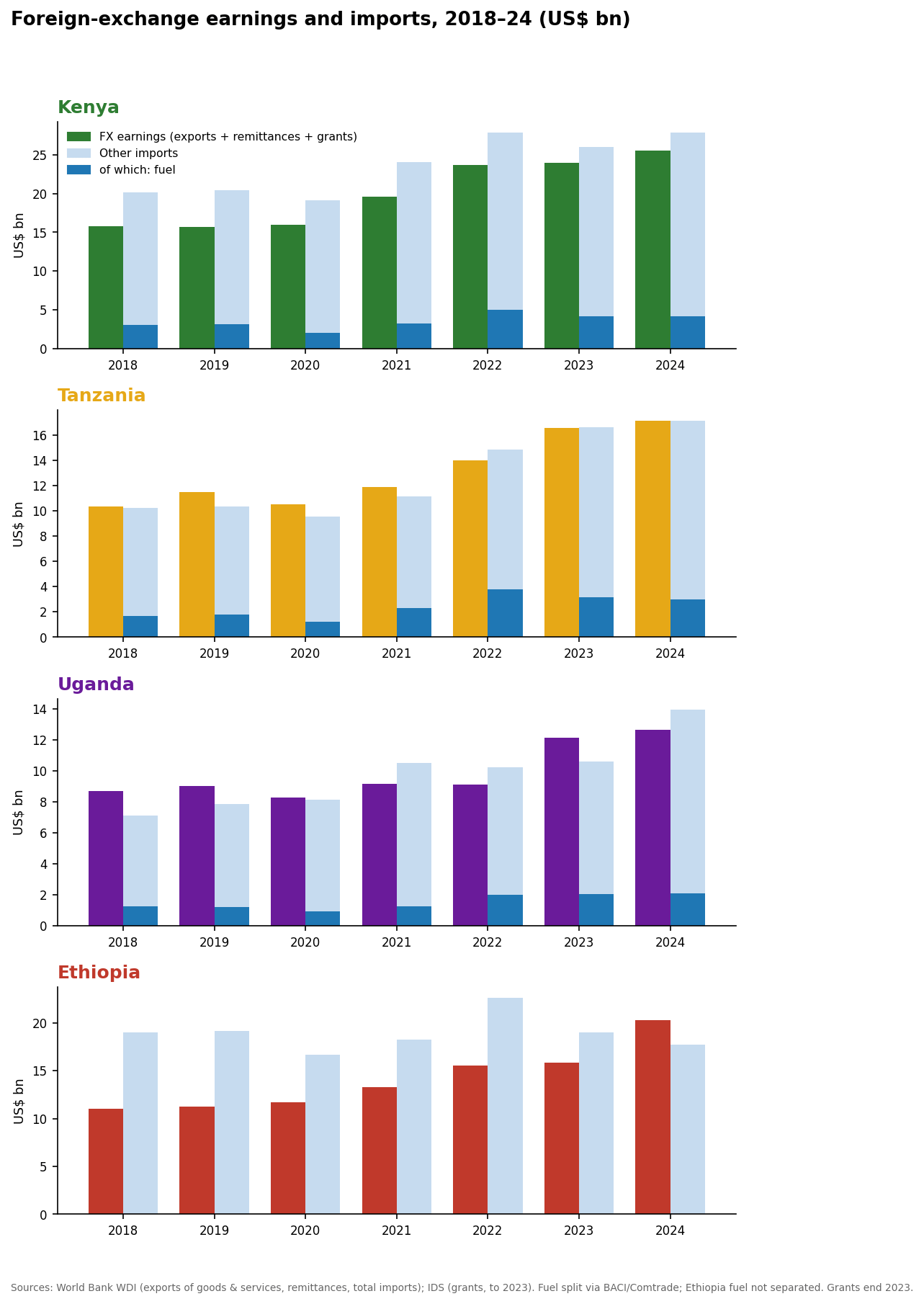
Fuel demand is relatively inelastic, so higher fuel costs land predominantly on the value of imports rather than on the quantity consumed. In Kenya for example, consumption fell by less than 3 per cent in 2022/23 even as the fuel bill rose an extra $1.8 billion, equivalent to 7 per cent of the previous year’s total imports. On their own, higher import bills may not have necessarily been insurmountable; export earnings across much of the region were rising too (although Ethiopia in particular had sustained large current account deficits).
Fuel drove rises in import bills in 2022 and 2023, but foreign-exchange earnings rose across most of the region too
The Russia-Ukraine war coincided with a global monetary tightening led by the US Federal Reserve. As the United States and other major economies raised rates to contain post-pandemic inflation, capital flowed out of riskier emerging-market debt. Issuing new dollar-denominated debt on capital markets became prohibitively expensive, just as higher import bills and interest payments were raising the demand for foreign exchange. Kenya, a regular issuer on international capital markets, was directly exposed to this kind of sudden stop. Ethiopia’s vulnerability was of a different kind: it had borrowed heavily, much of it bilaterally, to finance its state-led investment drive, and now carried a debt burden it could no longer easily refinance.
With import bills still elevated and external financing closed off, Kenya and Ethiopia had little choice but to find ways to choke off private demand for foreign exchange as pressures built into 2023. Total import bills fell by around 6 and 16 per cent respectively, while Uganda’s and Tanzania’s continued to rise. The adjustment ran through different mechanisms: in Kenya, a steady depreciation of the shilling, from about 122 to 167 per dollar; in Ethiopia, administrative rationing of foreign exchange and then a sharp devaluation in late 2024, bringing the official rate into line with the parallel market.
Kenya’s shilling slid in 2023 and Ethiopia’s birr was devalued in 2024. The region’s currency have held broadly steady so far in 2026.
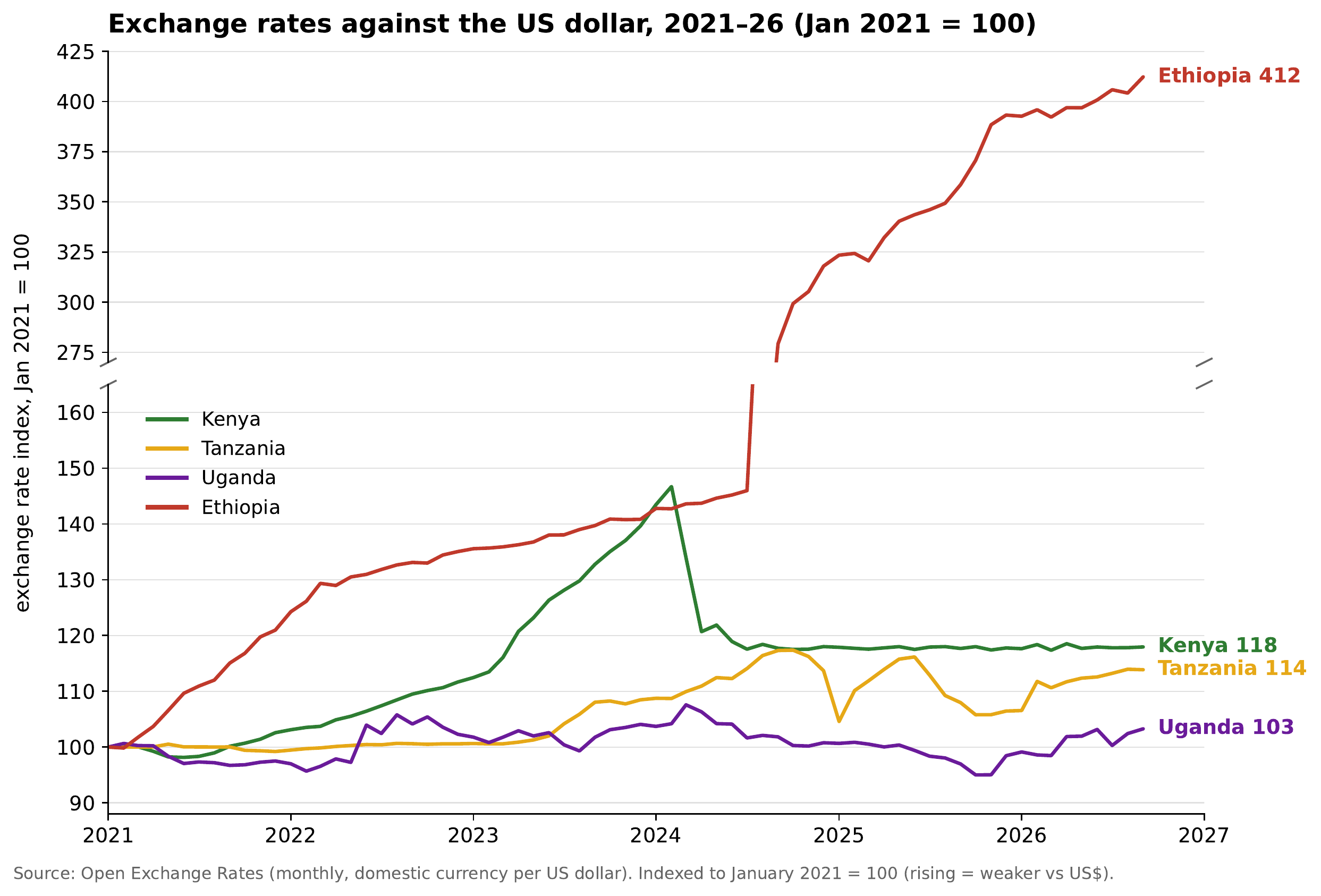
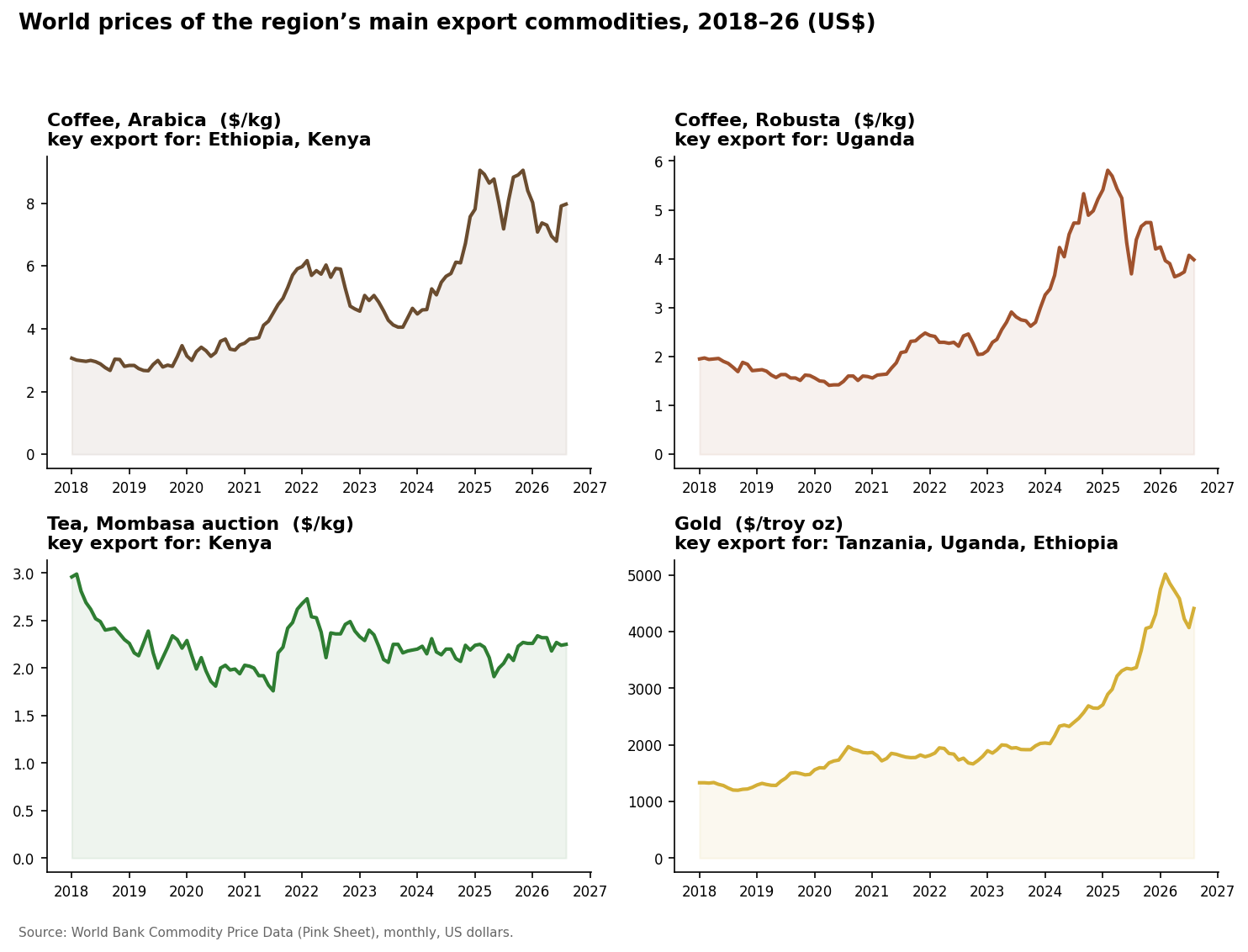
This year, exchange rate pressures have been seemingly more muted, reflecting relatively more benign external conditions. One key offsetting factor on the trade side has been the rising prices of the region’s key export commodities, most especially gold. Over the past two years, gold has risen sharply as investors have sought a safe-haven asset. For Tanzania especially, the benefit has been substantial. In the year to date, reports from the Reserve Bank show that fuel imports rose by around $1 billion, but gold exports by roughly $1.5 billion, more than covering the difference. Higher coffee prices have helped the region’s coffee producers too. The benefits of gold prices have not just accrued to the mining sector. Higher foreign exchange earnings have eased the pressure on central banks to devalue, which would otherwise have raised the domestic price of imported fuel even further.
The prices of the region’s main commodity exports have surged cushioning the impacts of a higher fuel bill
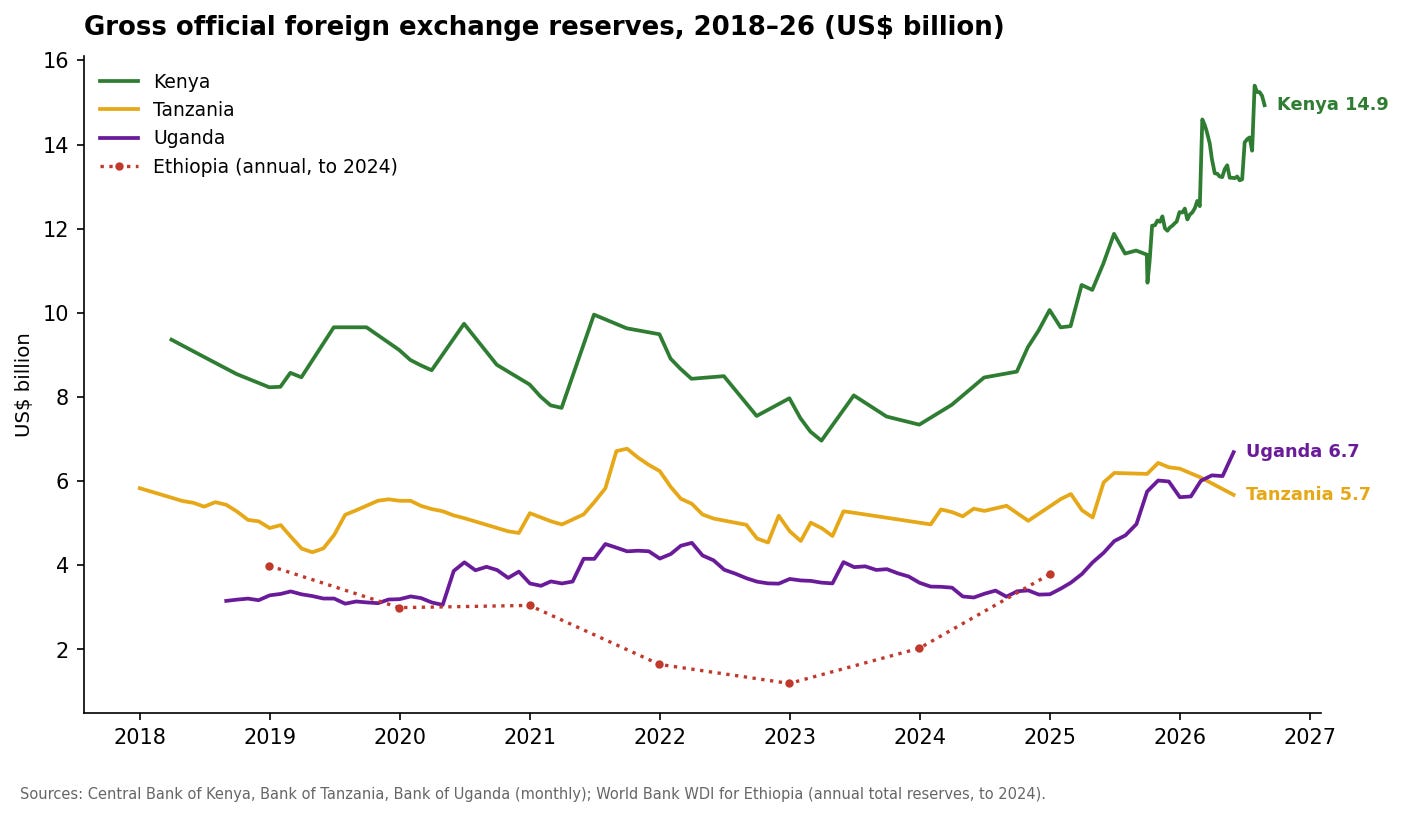
In the build-up to events in the Middle East, central banks have been using the same improved exports to rebuild the reserves run down in the previous crisis. Concessional borrowing (including through large World Bank development policy operations) and steadily growing remittance inflows have also been used to bolster the external position. The reserve position could still weaken if the high cost of fuel persists. Much of the fuel in the region is bought through relatively generous lines of credit and so will not have fully worked through yet (for example, Kenya’s ‘Government to Government’ arrangement provides a six-month credit period). Ethiopia has gone further still, reportedly securing fuel on credit terms stretching towards a year — an arrangement that defers the dollar outflow rather than removing it. Nevertheless, this build-up of foreign exchange reserves gives the Central Bank more breathing room to intervene if needed in foreign currency markets. This is less ‘luck’ than deliberate choice, in the same self-insurance logic that followed the East Asian crisis of the late 1990s.
Reserves run down in the last crisis had been deliberately rebuilt in the run-up to the Middle East conflict
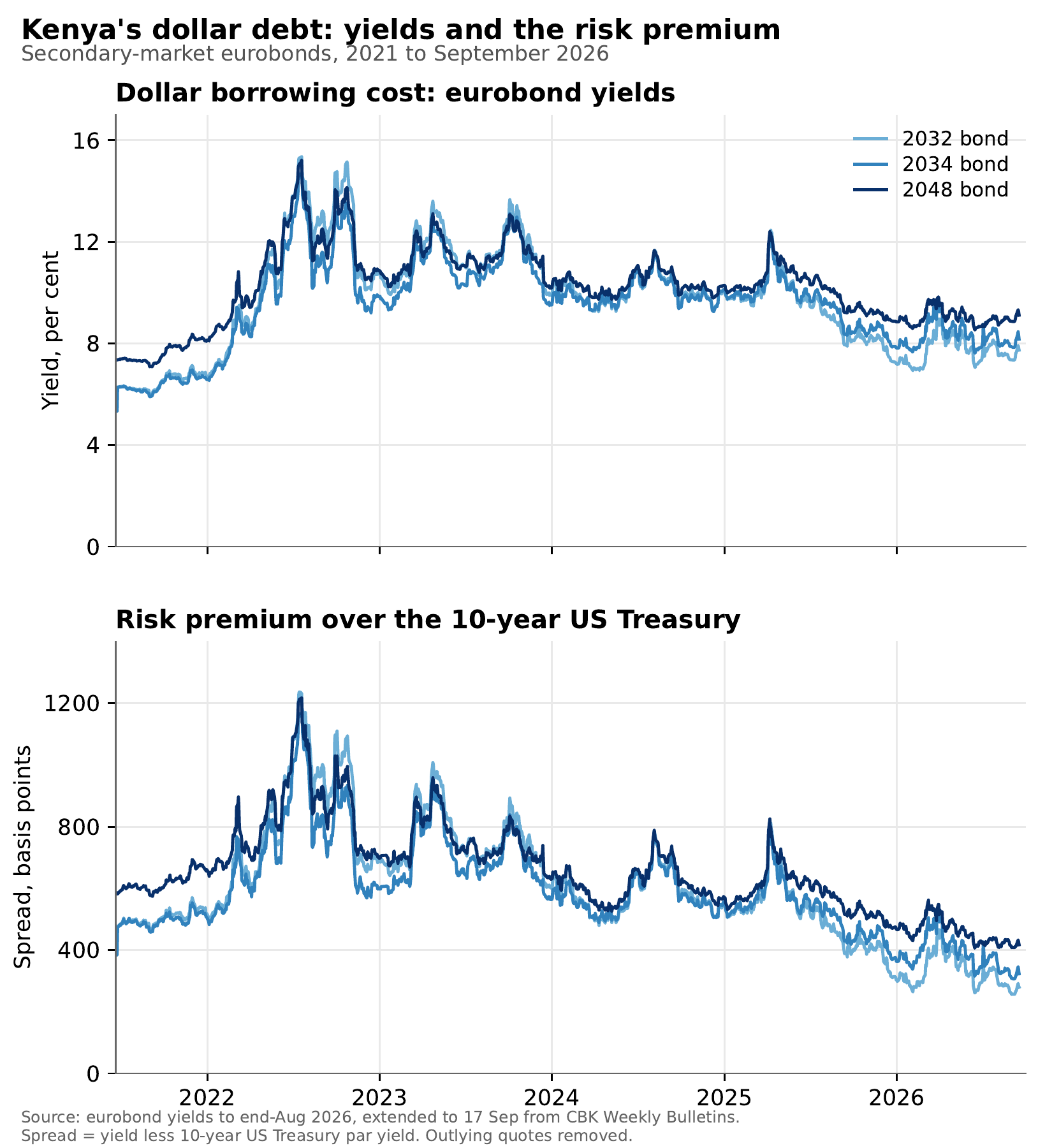
A second key difference relates to calmer international financing conditions in the year so far. Global rates may face upward pressure, but the charts below show that there has so far been no ‘flight to safety’ of the 2022 kind. If anything, the pressure has been on the traditional safe assets themselves: US Treasury yields have climbed as foreign holders reconsider their portfolios. Although yields have drifted up in recent weeks across all sovereign borrowers, Kenya’s sovereign spreads are at long-term lows. The financing squeeze that compounded the 2022 pressures has not recurred.
September’s rise in yields is a US-rates story. Spreads between Kenya’s dollar-denominated debt and US Treasuries are at their lowest since 2021.
3. The slower squeeze of building fiscal pressures
The surge in energy prices is not just an ‘external’ macro problem; it can also have implications for the public finances. This is in part linked to decisions taken around taxes and subsidies on the commodities in question. Ethiopia in particular has a history of subsidising fuel and fertiliser and the removal of costly fuel subsidies was one of the conditions for accessing the 2024 IMF programme.
It is difficult to get an up to date read on public finances. The government of Ethiopia has reintroduced subsidies on diesel since the onset of conflict earlier in the year with a view to cushioning drivers from the full hike in costs. Tanzania and Kenya, which raise significant revenue from fuel taxation, have also taken measures to ease the full pass through of more costly imports (although higher fuel prices also mean higher ad valorem revenues).
The chart below shows that interest payments have been steadily building as a share of revenues across the region, rather than a sudden jump in the face of specific shocks. Some of the rising interest burden relates to the international debt story: the dark blue bars have grown since 2020 as interest rates have risen internationally. Where currencies have depreciated, it has contributed to a rising local-currency cost of servicing external debt.
Interest costs on external and domestic debt have climbed steadily as a share of revenue.
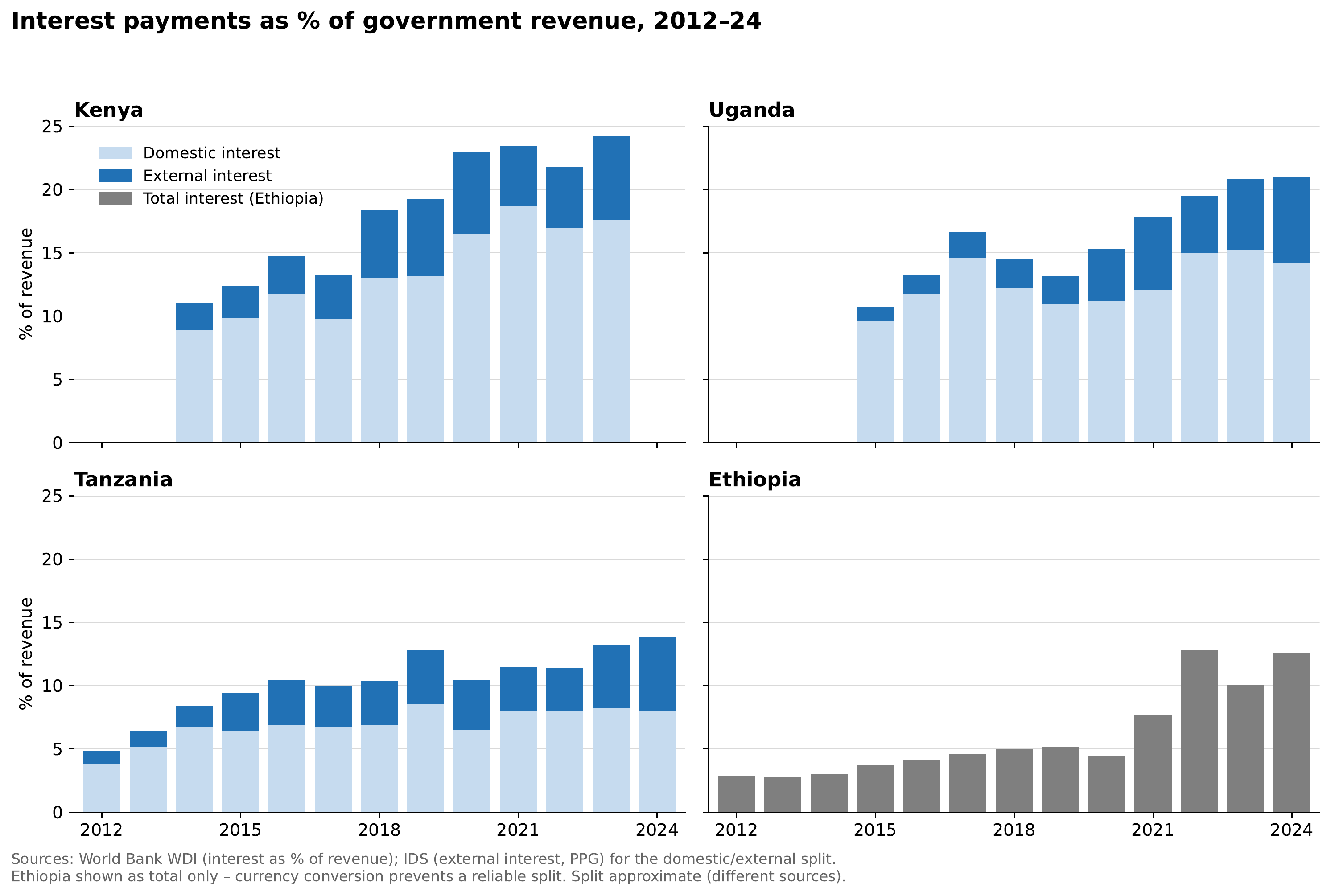
However, a large portion of interest costs is linked to the domestic debt burden shaped by borrowing decisions and the performance of the economy including during the Covid-19 pandemic, but also during the 2010s. A debt ratio falls only when an economy grows faster than the interest rate it pays on its debt; where a succession of shocks pushes growth below that rate, debt no longer stabilises of its own accord. It instead requires that a finance ministry finds savings to pay back debt through achieving a primary surplus (or ultimately seeking to restructure debt with the associated fall-out).
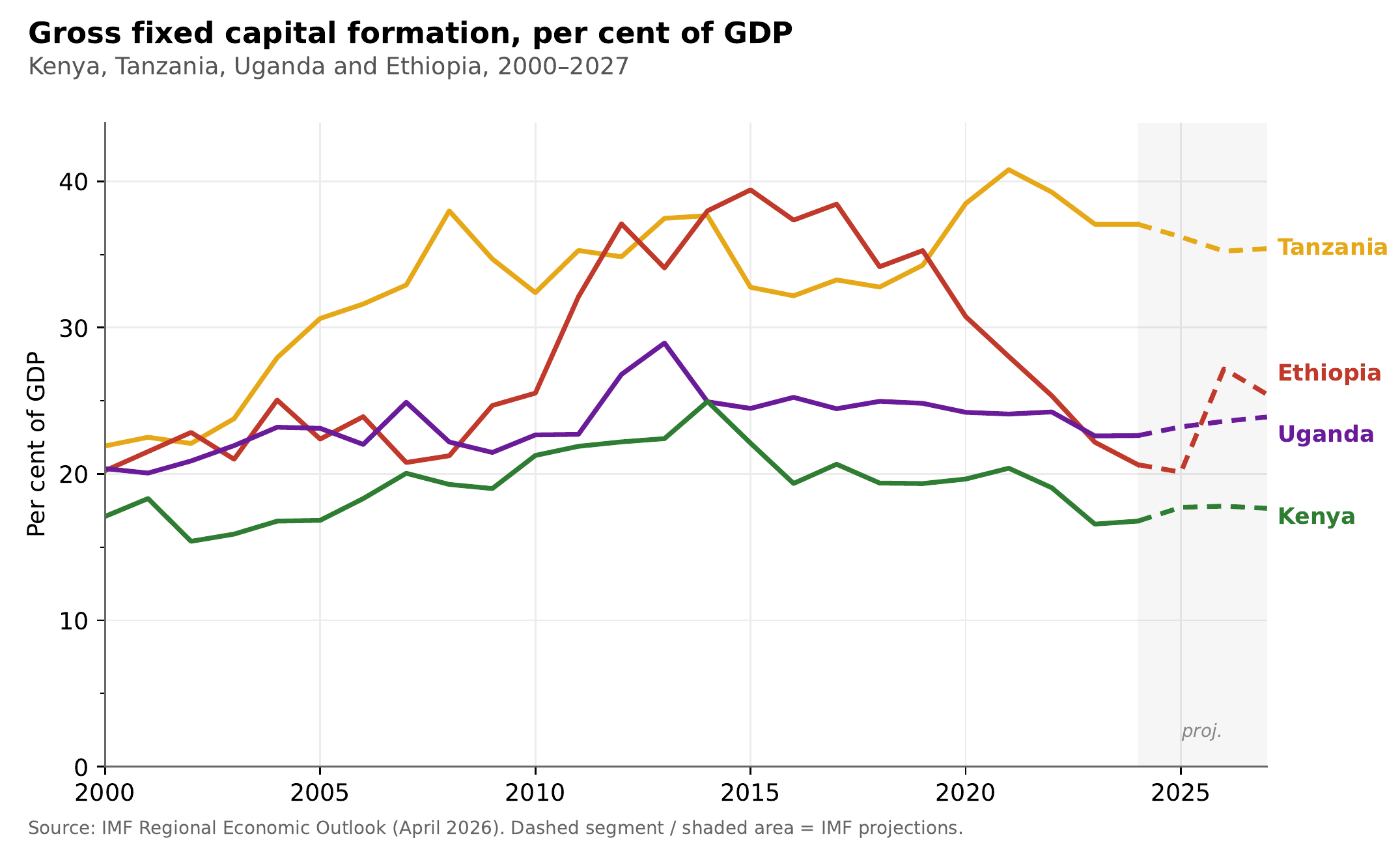
Concerns over rising debt levels as well as required external adjustment (and the contraction of imports described above) have led to a squeeze on fixed capital investment in Ethiopia and Kenya relative to the previous decade. Investment (both public and private) can undoubtedly be used well or badly, but building out the capital stock is key for further building up the economic resilience required to deal with future shocks.
Fixed capital investment has fallen in Ethiopia and Kenya following the debt-driven expansion in 2010s.
4. The road ahead
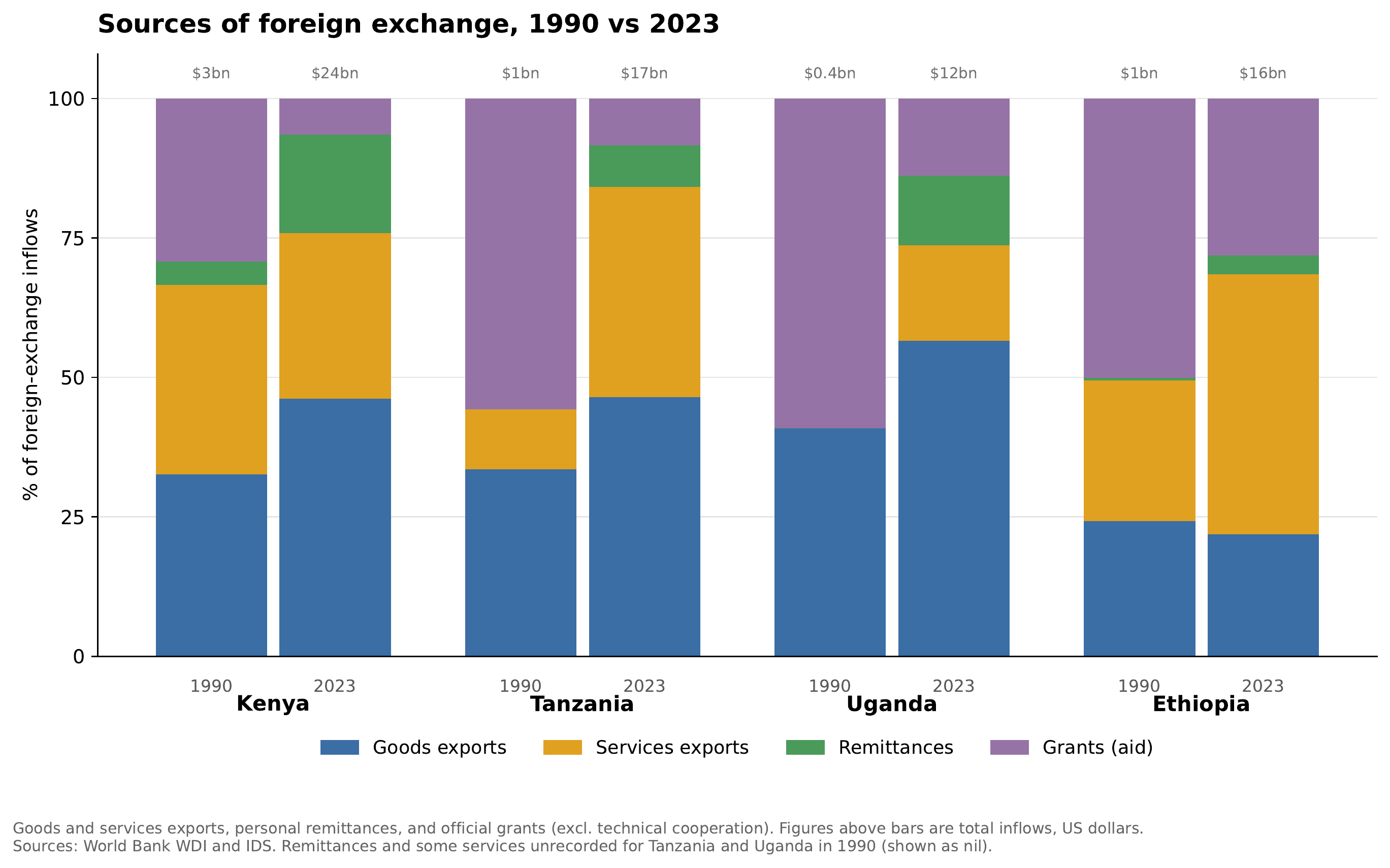
I started out by echoing the warnings of Opalo, Usman and Ang against the tendency to catastrophise. This is not the 1970s or 1980s, when energy shocks tipped many economies in the region into debt crises and ‘lost decades’. Countries in the region are much better placed to withstand a trade shock. Foreign exchange earnings are significantly greater, and economies less reliant on aid inflows. Trade in services and remittance inflows have come to play a much more important role.
The region has expanded and diversified its sources of foreign exchange
For the economies looked at here, 2026 has so far not been as severe a crisis as 2022 when the term ‘polycrisis’ was the flavour of the hour. Crises can cascade and compound, but bad things do not necessarily all go together. Over the past seven months the region has been buffeted by higher fuel-import costs. However, it has also gained from the efforts to diversify reserve holdings beyond US Treasuries that have led to a higher gold price and relative calm in emerging-market bond markets. The global fertiliser market (for urea at least) has also responded quickly to shortages in the Gulf.
That said, some of the strain is deferred rather than avoided. Higher input costs are still feeding through to retail prices. Much of the region’s fuel has been bought on extended credit, so part of this year’s import bill in dollars has yet to fall due. Should events in the Middle East slow growth, the debt arithmetic would worsen too, further squeezing fixed capital investment the region can ill afford to lose.
The conflict in the Middle East is of course still playing out. Over the short-term, the economies of the region remain highly exposed to developments in global diesel markets over which they have limited influence. If too little refined diesel reaches global markets and diesel prices remain higher for longer, then there are risks not just of higher prices, but the spectre of potential shortages and renewed pressures on the balance of payments. Ethiopia would be especially vulnerable given its thin foreign exchange reserves. In recent days there have been reports of renewed conflict in the Tigray region. Shifting sentiments towards gold or emerging market debt would also heighten pressures on the region’s economies. The strengthening El Niño, and the flooding it could bring, add yet another layer of uncertainty.
However, the external conjuncture is not long-term destiny. Policy makers within the region are looking at ways to reduce the vulnerabilities of importing critical commodities through concentrated supply routes. Kenya is reportedly moving forward with exploiting its oil reserves in Turkana, as well as investing in a refinery. Uganda is poised to start supplying crude to the regional market and is looking for investment in a refinery. Tanzania is building oil storage facilities and looking at ways in which it can substitute natural gas for oil in transportation. Ethiopia is going ahead with investment in industrial-scale fertiliser production that will draw upon domestic natural gas reserves. The investments in question target vulnerabilities in particular commodity markets, but can also serve to strengthen the external position of the region’s economies by bolstering export revenues and/or reducing import requirements.
These are, in the main, fixes to particular import dependencies. They matter, but resilience also stems from a broader, more sophisticated export base that earns foreign exchange from more sources and leaves an economy less hostage to any single commodity price or import bill. The rising weight of services and remittances points that way; as, more ambivalently, does the gold boom now cushioning parts of the region, a windfall whose real test is whether it is used to broaden the export base over the longer-term.
In that respect, the vulnerabilities revealed by events in the Middle East (or the Russia–Ukraine conflict before it) should not be read only as fragility. Albert Hirschman argued that development is driven less by balanced plenty than by the tensions and bottlenecks that force a response: a shortage in the right place is a signal and a spur, calling forth investment that easier conditions, or generalised exhortations to ‘Build Back Better’ (remember that?), never would. Much of what this piece has traced can be read in that light. Ethiopia’s reliance on imported fertiliser is the by-product of a real productivity gain, and the bottleneck it creates is lending fresh urgency to the domestic fertiliser production that could relieve it. The scramble for kerosene and diesel is doing the same for refineries, storage and a turn towards domestic sources of energy, renewable and fossil alike. Whether this decade’s bottlenecks become a source of dynamism, or simply of doom, will depend on how clearly their mechanics are traced, and how well they are answered.
[1] Phosphate depends on a scarce mined rock. China, the world’s largest producer, has restricted exports since 2021 to protect its own domestic supply. A newer, structural source of demand, booming production of lithium-iron-phosphate batteries, adds to the pull on global phosphate. Either way, it is a tightness that predates the disruption in the Gulf and will outlast it.